Probably the biggest complaint I have about the word “discourse” is that it conflates two concepts that used to be separate: wank and meta. The differences are important.
Meta was a discussion. It was meant as a jumping off point to look at a complex issue. It dignified its subjects by treating them with the maturity they deserved. It was reflective and enriched by multiple points of view. Whether serious or light-hearted, meta thrived on presenting evidence and discussing the impact of that information. Its purpose was to get everyone involved thinking more deeply about a topic, often including the OP.
Wank was wank. Whether it was ship wars or personal vendettas, wank was about in-fighting. It was ~ drama ~. It was there to start a fight it planned to win, and winning was its only goal. It was frequently superficial and careless in its impact, and it generally rested entirely on either false evidence or no evidence at all. It was the stuff that made gawking into a major fandom passtime, via fandom_wank and other resources.
This doesn’t mean there wasn’t poorly thought-out meta, or that no wank ever did something good. (Some wanks were very good at teaching everyone important lessons, like that you need to know what you’re doing in order to run a con, and not to harass actors.) It’s not about the tone, either – I’ve seen some very angry meta and some light-hearted wank bait.
The difference is entirely in approach. Meta frames itself as part of a dialogue and actively invites participation and alternate interpretations of the data. Wank declares itself the one true way and actively invites popcorn and/or everyone running for cover. Meta understands that there are multiple truths in terms of personal experience but that facts, such as they can be determined, are important as a base to work from. Wank is about what someone thinks should be the facts, in the face of all evidence to the contrary.
Prior to tumbl-hell, it was understood that feeding the trolls was a bad idea. When fans wanked, most others noped out. But now, with this new “discourse” term elevating ship wars to some sort of art form and dignifying arguments which we used to understand were full of baloney, people feel required to engage. Instead of pointing and laughing from a safe distance, we’re feeding the very worst trolls and giving them the power to convert others to trolldom and harass anyone who doesn’t conform to their wank-defined rules.
The thing is, we did this before. In the 90s. It sucked. The point of the term “wank” was to recognize the self-congratulatory nature of the (probably universally human) behavior, box it, and set it to one side. We couldn’t stop it from starting, but we could choose not to feed it. Now it’s out of the box again, and it has not improved with age, let me tell you. Phew.
So, petition to bring back both terms and drop “discourse” like a rotten potato. It’s not useful, because it conflates real conversations with standing in a room screaming with one’s fingers in one’s ears.
This reminded me of an article I read a couple of months ago that stuck with me. It was about talking to Trump supporters, and how the two approaches of either always blowing them off as racist idiots who can’t be reasoned with, or approaching every interaction as an earnest attempt to see their point of view and to introduce other perspectives, are not viable.
The thesis was that there are basically two types of conversations that can happen when we talk about ideas. Some people*, even if they hold views we find odious, base those views on perceived facts–those facts may be incomplete or erroneous, but they are operating in good faith in that they believe that facts matter and opinions should be somehow grounded in facts. Other people, even some who hold views we agree with, use opinions and facts interchangeably, as a way of making a point about identity and belonging. They will say that they believe what they understand their group to believe, and it doesn’t matter if that belief is an opinion, a fact, or a straight-up lie.
Someone who’s arguing in Style A might say, “Global warming is bunk; the last couple of winters have been the coldest I can remember.” What they mean is, “I have made a conclusion based on the facts immediately available to me.” They may not be curious enough, or educated enough, or have enough time on their hands to seek out additional facts upon which to base their conclusions, but there is a fact in there somewhere, and they care about it. Show that person a map charting average winter temperatures across the globe, and point out how a portion of North America (the portion where I and my imaginary interlocutor happen to live) is the only place that recorded lower temperatures than usual, and everywhere else on the planet was higher, and that person might reconsider, or at least conclude that they don’t understand the topic as well as they thought they did.
Someone arguing in Style B might say, “Global warming is bunk because environmental regulation hurts jobs.” What they mean is “People in my group believe that global warming doesn’t exist, and that environmental regulation takes away people’s jobs. The connection between these two statements is that they are both things that people in my group believe, about the same broad topic area.” This person does not care whether either of these statements is literally true. Either one can be used to justify or “prove” the other, but presenting evidence against one won’t weaken the speaker’s belief in the other–or even the first one, probably. Presented with facts that challenge their beliefs, this person will double down on those beliefs, because you aren’t having a conversation about what is true about the world; you’re having a conversation about what kind of person they are. And you, a stranger of the internet (or a co-worker around the water cooler, or a distant cousin at the family reunion) are not going to change their mind about what kind of person they are.
So the best approach is to gently engage with Person A (if you have the time, facts, and spoons to do so), but leave Person B alone. But the hard part is, you can’t always tell which type you’re dealing with. The only solution is to make the best call you can, based on the available evidence. If you make the wrong call, and get into an argument with someone using Style B, don’t beat yourself up over it, but be aware of the sunk cost fallacy–when you realize your mistake, just walk away.
The bolded point above is, I think, really important, because for those of us who have been socialized to Not Feed the Trolls, it’s really embarrassing to realize we’ve done just that. It’s tempting to keep hammering away, trying to either turn it into the Style A discussion you thought you were having, or at least score some points so you don’t look stupid. But there’s not really any point, unless you’re performing for an audience whose views you might change, or whose opinion of you is important to you.
So those are my thoughts about The Discourse, and they’re as relevant to fandom wank as they are to Srs Bzns.
(*I say “some people” here as a shorthand; of course, the same person may argue in Style A in some situations and Style B in others.)
y’all, calling wank ‘discourse’ is sarcasm.
Category: Uncategorized
“wouldn’t you rather earn something than have it just handed to you?”
Yeah when it comes to actual awards and fancy goods, but when it comes to basic needs, basic human decency, and accomodations, those things should always be handed to people. No one should have to “earn” those things.Value people as people, not base it on how much they produce.
yeah but that creates a severe dependency that could be exploited easily, and creates a slippery slope @musical-clarity
Actually studies show that people who live in places with universal income (who are given money with no strings attached just for being citizens) do far better work than those who don’t and are more enthusiastic to do work.
This is because they still want nice things and will work for those but the part of their energy that was devoted to worrying about if they have enough money to pay the rent and bills this month is now freed up to do other things.
Some people will always be lazy and take advantage of the system, but they are always a tiny percentage and it seems ridiculous to me to punish the majority and severly hamstring their abilities just because a handful of people will simply live of basic income rather than work.
It’s been tested a couple times. In Canada, in some European countries, and the results are always the same.
There are two groups of people who show a statistically significant (Greater than one half of one percent, or 1 in 200) increase in Not Working and living off the guaranteed income. Parents of Children under school age, and full time students.
Among ALL other groups, employment actually INCREASED. Why? Because guaranteed minimum income means that homeless people can get at least a basic low end apartment. It’s hard if not impossible to get an above board job without a permanent fixed address. Also more people were able to have and maintain a BANK ACCOUNT. It is often hard to get a decent job without an account that can accept Direct Deposit for paychecks.
Also, lost work time due to illness and injury decreased across the board. It turns out if people are getting a decent amount of money each month they can A> afford to eat better, and B> obtain decent medical attention both preventative and emergency. Crazy right?
So why hasn’t it caught on?
Because it doesn’t directly benefit the people in power, and it increases THEIR PERSONAL taxes, their CORPORATE TAXES, and thus decreases their PERSONAL INCOME.
So, because Jeff Bezos and Alan Greenspan might fall from making 100 billion dollars a year to making 99.8 billion dollars a year, it’s a hard NO and we can all fucking die..
The End.
The other reason the people in power hate it is because it fundamentally changes the relationship between employer and employee. In regular capitalism, the employer has all the power because if you quit you starve and if you get another job it’ll be equally shitty because all the bosses know that they have you by the gonads.
But with universal income, power is given to the workers. If your boss is an asshole, you can just quit without worrying about starving. So the employers are the ones that have to sell themselves and offer value for your time in order to keep enough staff to survive. And they HATE that.
Today I finally managed to re-register to vote. I’ve been meaning to do this since we moved, but it was complicated and the state of California’s website was a hassle and it required me to mail things and the baby ripped up the thing they mailed me and altogether it was just not going to happen. The reason it finally happened was that I asked for help.
I filled out a short form on vote.org, so I didn’t have to interact with California’s website. They mailed me something to print, and my housemate printed it and brought it to me to sign. I signed it and he put it in the mail. Now I’m registered.
If you’re like me and find bureaucracy interactions terrifying and hard, and don’t expect to succeed at them and as a result you often don’t try, I recommend this: set a timer for ten minutes. Go to vote.org and spend ten minutes taking steps that move you closer to being registered to vote. You are reasonably likely to succeed and be registered by the end of that, or to have enough momentum to continue. This matters – it may not matter if just you do it, but it matters very profoundly if all the people like you do it.
You are not a bad person because you haven’t gotten this figured out yet. You are not a failure because you haven’t gotten this figured out yet. You are not less worthy of a voice in our democracy because you haven’t got this figured out yet.
Mute this. The music is annoying.
Follow @brattylikestoeat for more.
this is what insomnia sounds like
Soundtrack of Executive Dysfunction.
fam I’m over here having a laughing fit, tf is this music😭
mario party minigame music


via ift.tt
Yep. It also correlates extremely strongly with an increasing decrease of violent crime. One of the symptoms of low level constant lead exposure is increased aggression and volatility.
“Unknown scientist”? That was Clair Cameron Patterson.
Everything You Should Know About Anarchism
Teen Vogue does it again!!! Guillotine Vogue!! This is honestly an amazing introduction to anarchism and I can’t believe Teen Vogue published this!
i can lmao
Chapters 8 and 9 of Shamefully Yours are now posted. You can find them on A03 here:
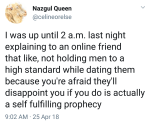

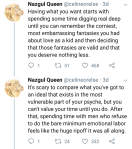


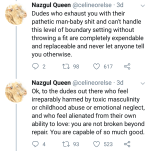


Emotional Labor: What It Is and How To Do It
via Celine Loup
whoa
Girl is in charge.
I thought this might be irrelevant to me but it’s got great advice on what to do when someone ignores something that you tell them repeatedly that you hate/makes you uncomfortable/feel like shit
 ugh
ugh 